Get Your Fix With Public Domain Day 2026: Newly Available Books, Films, Music, and Characters
| Footnotes for this article are available at the end of this page. |
Key Takeaways
- Public Domain Day 2026 releases thousands of creative works for free use. As of January 1, literary works from 1930 and sound recordings from 1925 are now available without copyright restrictions.
- The expanding public domain fuels new creativity and innovation. Copyright expiration reflects its core purpose: encouraging creation while ultimately returning works to the public for reuse, adaptation, and inspiration.
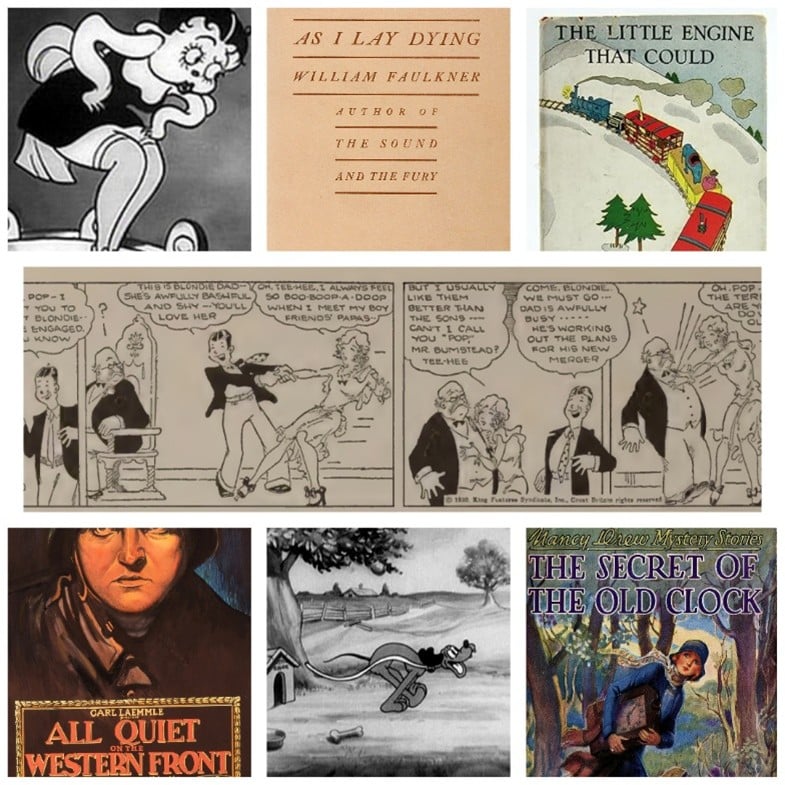
On January 1 of every year, we celebrate Public Domain Day — when long-held copyrights expire and a new batch of works become free for the public to use. This year, we’re gifted with thousands of works from 1930 and song recordings from 1925. These works are now in the public domain, meaning that after 95 years or so1 of being “off limits,” they are finally fully available for everyone to access and use without authorization.2
This year’s “presents” include literary works such as William Faulkner’s A I Lay Dying; the first four Nancy Drew novels; books by Agatha Christie, T.S. Eliot, and Sigmund Freud; and an illustrated version of The Little Engine That Could. Cartoon characters such as Betty Boop and Pluto have also been liberated,3 as have nine new Mickey Mouse cartoons and comic strip characters Blondie and Dagwood. Public domain films now include Murder! by Alfred Hitchcock and All Quiet on the Western Front. Songs that are now free to use include “Georgia on My Mind,” “I Got Rhythm,” and works by John Philip Sousa, as are certain sound recordings of “Sweet Georgia Brown” and “The St. Louis Blues.”
While Public Domain Day is a relatively new holiday, the ideals it celebrates are timeless. When books, films, and music enter the public domain, they become part of our creative inheritance. Indeed, one of the reasons copyright protections exist in the first place is to incentivize creation to ensure a well-stocked public domain from which future generations may draw to create even more works. Public Domain Day honors one stage of this cycle. It’s up to us to complete the other stages by using the rich cultural heritage found in our public domain to create new works that entertain and challenge for posterity as part of an unbroken chain of inspiration going back through time. And yes, that even includes Betty Boop slasher films.
[1] The precise copyright term length depends on several factors. Generally, works published before 1978 are protected for 95 years. Works by natural persons created before 1978 but never published have a copyright term of life-of-the-author-plus-70 years. And works by natural persons created after 1978 are also protected for the life-of-the-author-plus-70 years. In addition, sound recordings have their own rules. For example, sound recordings first published between 1923 and 1946 have 100-year terms. Of course, these term lengths are only applicable to the United States as other countries have different copyright protection windows.
[2] But don’t go too crazy. While copyright protection for these works may have expired, the works may still enjoy other forms of protection, such as trademark. However, trademark protection simply means you can’t use public domain character names and designs on merchandise as brand signifiers. This shouldn’t prevent you from using 1930 Betty Boop in a new creative work as long as consumers aren’t confused into thinking that you’ve created a product sponsored by the owner of the Betty Boop trademark.
[3] Post-1930 versions of Betty Boop and Pluto may still be off limits. This is because where fictional characters “evolve” over time, courts have found that a copyrighted character falls into public domain along with the first published story featuring that character, though aspects of the character’s development that appear in later works that are still under copyright remain protected from public use.
- T. Chase Ogletree
Associate
