Fruit on the Front, Sugar on the Inside: What a Frozen-Pop False Advertising Fight Means for Food Companies
| Footnotes for this article are available at the end of this page. |
Key Takeaways
- A competitor — not just a consumer — can bring a federal false advertising claim under the Lanham Act based on misleading food packaging, and a Texas federal court recently let such a case proceed past a motion to dismiss.
- Back-of-package ingredient lists do not cure misleading front-of-package imagery. Courts have held that consumers should not have to flip the box around to learn the truth.
- Food and beverage companies should treat front-of-package claims and imagery as advertising statements that must be independently defensible.
A pending lawsuit between two frozen-treat companies is a reminder that food advertising disputes are not limited to consumer class actions or FTC enforcement. Under the Lanham Act, a competitor can sue over misleading marketing, and as the case below shows, packaging choices can quickly become courtroom exhibits.
GoodPop v. JonnyPops: The False Advertising Claims
In June 2024, GoodPop sued competitor JonnyPops in the Western District of Texas, alleging that JonnyPops’ frozen-pop packaging violates Section 43(a) of the Lanham Act1 and California’s Unfair Competition Law.2
The core facts are straightforward. JonnyPops’ “Fruit Stacks” line features prominent fruit imagery on the front of the box and markets itself with claims like “simple ingredients” and the “wholesome nutrition of a fruit bar.” However, the top two ingredients are purified water and organic cane sugar. Actual fruit content is estimated at less than 2%, and the products contain roughly 66% more added sugar per fluid ounce than a Coca-Cola. See the screenshot below.
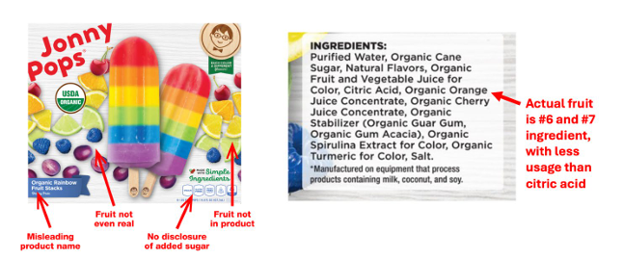
GoodPop supported its claims with consumer survey data: nearly 50% of respondents believed the product is primarily made of fruit, and 61% believed most of the sugar came from fruit rather than added cane sugar. GoodPop alleged its own sales declined roughly 25% at a retailer where both products appeared side-by-side.
Why the Court Allowed the Lanham Act Claims to Proceed
In March 2025, the court denied JonnyPops’ motion to dismiss, finding that GoodPop plausibly alleged all elements of a Lanham Act false advertising claim. Notably, the court rejected the argument that the ingredient list on the back of the package cured any misleading impression created by the front. Citing Blue Buffalo Co. v. Nestle Purina Petcare Co., the court held that “the mere presence of an ingredient statement on the back of the product ‘does not eliminate the possibility that reasonable consumers may be misled.’” The court also rejected a puffery defense, finding that fruit imagery combined with phrases like “simple ingredients” can be actionable.3
JonnyPops then filed counterclaims alleging that GoodPop’s own advertising is also misleading. Specifically, JonnyPops challenged GoodPop’s claims that its products “never have refined sugars” and are made with “real, whole fruits, juices and purees,” as well as the fruit imagery and product names on GoodPop’s own packaging. The counterclaims underscore that these disputes cut both ways — any company making health-forward claims about its products is a potential target. As of July 2026, both sides have filed cross-motions for summary judgment, and trial is set for November 30, 2026.
What Food and Beverage Companies Should Do Now
- Treat front-of-package imagery as advertising. If your packaging features pictures of fruit (or any ingredient), the product should actually contain meaningful amounts of that ingredient. Courts will not treat these images as mere decoration.
- Do not rely on back-of-package ingredient lists as a disclaimer. Courts have made clear that fine print on the back does not cure a misleading front panel.
- Scrutinize product names and taglines. Names like “Fruit Stacks” and phrases like “simple ingredients” or “wholesome nutrition” can become the basis of a lawsuit if the product does not deliver on those promises.
- Remember who can sue you. Under the Lanham Act, only competitors, not individual consumers, have standing to bring a false advertising claim seeking damages, disgorgement, and injunctive relief. But that is not the full picture: consumers may bring claims under state consumer protection statutes and class action theories, and the FTC and state attorneys general can pursue enforcement actions under their own authority. The threat is multi-directional.
- Consider the cumulative impression. Courts look at packaging, website claims, social media, and retailer materials together. A single element might be defensible in isolation but misleading in combination.
The GoodPop v. JonnyPops litigation is ongoing, and the recently filed summary judgment motions may further clarify the boundaries of permissible food marketing. In the meantime, companies should take a hard look at their packaging and ask a simple question: does the front of our box accurately reflect what is inside?
How AGG Can Help
AGG’s Intellectual Property team advises food and beverage companies on advertising and marketing compliance, product labeling, false advertising claims, competitor disputes, and risk management. If you are evaluating new packaging, launching a product, or responding to a false advertising challenge, our team can help assess legal risk and develop practical strategies to protect your business. Contact a member of AGG’s Intellectual Property team to discuss your packaging and marketing review.
[1] 15 U.S.C. § 1125(a) (Lanham Act, Section 43(a)).
[2] Austin’s Natural Frozen Pops, Inc. d/b/a GoodPop v. Jonny Pops, LLC, No. 1:24-cv-00716 (W.D. Tex.), filed June 2024.
[3] Pizza Hut, Inc. v. Papa John’s Int’l, Inc., 227 F.3d 489, 497, 501-02 (5th Cir. 2000).
- Thomas J. Caulfield
Associate